







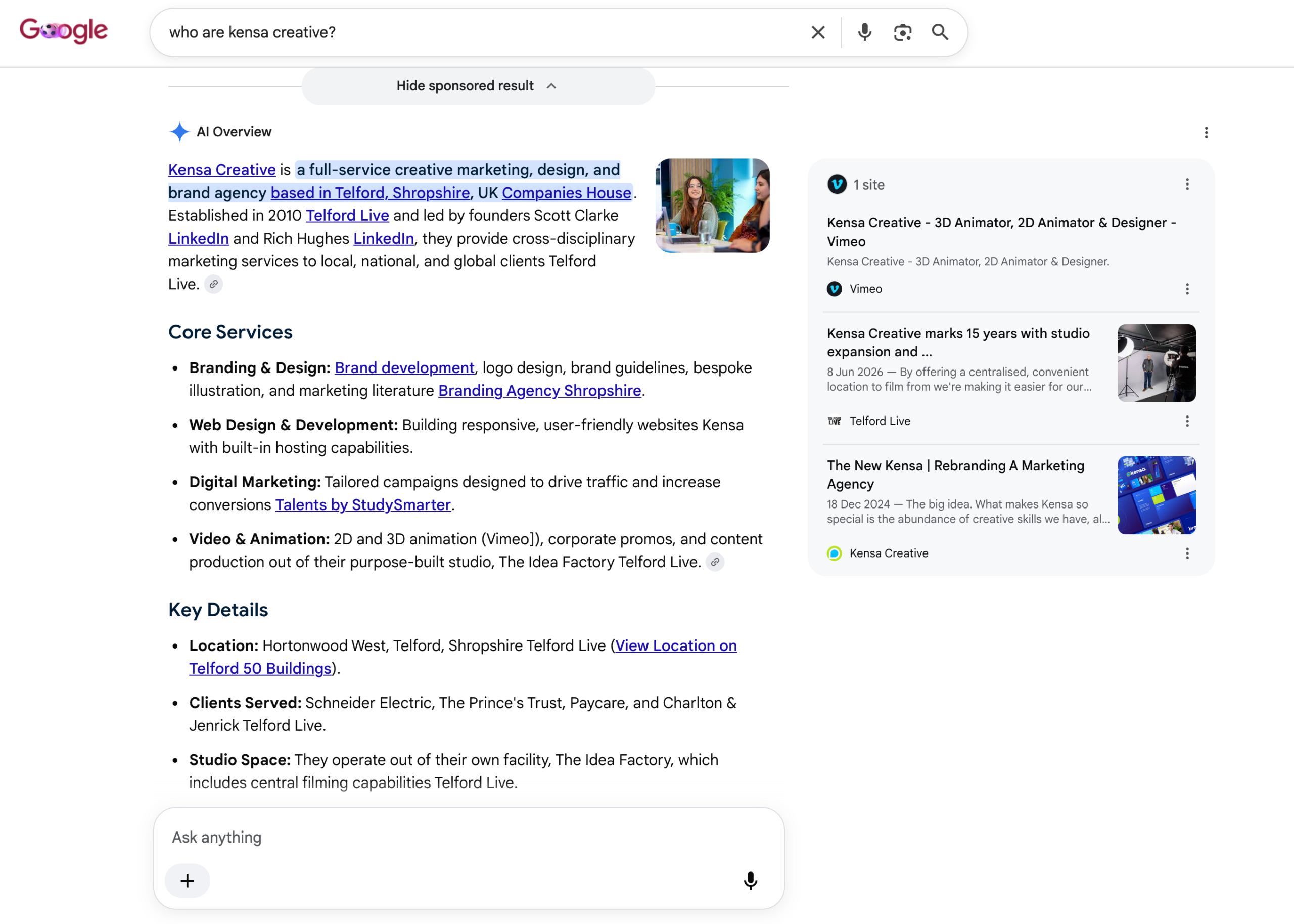
Simply put, search marketing has changed. It’s no longer about targeting content that’s filled to the brim with keywords and iterations of your keywords to rank. It’s all about catering to human users and real-life questions. The surge of voice activated searches thanks to Gemini and Siri has paved the way for what we want today – quick answers to our burning questions.
But what does this mean for your brand’s website? And how can you help get your website content to be cited within AI results?
Firstly, your content need to pivot towards answering questions directly which relate to user searches – and have a clear connection to your brand. But more than this, the answer needs to be direct, or at least structured in a way that is clear your website holds the answer. Clickbait style content where a user is dragged down a page of long form content only for the answer to be at the bottom – and with limited information – is so 2025. Having a direct answer within the first paragraph means AI models can scope the relevance of your content immediately. And, wherever possible, your article header should also be the question that is being searched for and answered.
Why does AI need clear headings in content?
AI models read a lot quicker than us humans, and are generating an answer to a search query in seconds and to do this, they have to quickly, but effectively skim through large volumes of data. Clear headers for sections of an article allow AI models to efficiently interpret content and scan the page to measure if the information needed is available within the web page. According to SE Ranking, content separated into sections of 100-150 words with clear headings earns around 4.7 AI citations.
Why does AI search need alternative text for images?
AI platforms like Gemini and ChatGPT are Large Language Models (LLM’s), proficient in understanding text. The architecture of these AI models is based solely on an understanding of being able to apply context and summarise text based content, such as text and code. As a result, AI models need a little help when it comes to images and measuring their relevance. This includes clear, descriptive text of what the image is ensures the content retains relevance in the eyes of AI, increasing citation likelihood. It also supports your overall SEO for image search results, so its a win:win.
Why do I have to continually update my content for AI search?
AI understands that the user is looking for content that gives them information that’s relevant to their search but over time, your contents’ relevance will decline as new information surfaces. For example, you’ve clicked on this article after a search for “How do I get my website to appear in AI search results?”. At the time of writing, the information in this article is factually correct and will improve your chances of AI search citation.
But AI models continually learn and algorithms will continually be optimised in the future. This basically means that for us, this content will become out of date within a matter of years (maybe months, who knows where AI will go next?). According to research from Ahref, AI cites content that’s 25.7% fresher than traditional organic Google results. What this means for marketeers is that content that’s performing highly still needs to be updated to retain citation volumes.

I’ve always written for SEO, is this not relevant anymore?
Any traditional SEO’s don’t need to worry, most of your practices are still relevant. In fact, AI models are trained to measure a piece of content’s trust and relevance on a lot of the same principles as traditional search engine algorithms. A lot of what we’ve covered in this blog are principles digital marketeers are likely familiar with if they’re used to authoring content for SEO already.
AI models will still use the EEAT model (Expertise, Experience, Authority & Trustworthiness) in it’s decision to cite content like traditional search results so when it comes to developing your content plan, much of your previous practices are the same. Where you need to change tact is the focus points of your content, and where you get your research from. Using AI itself is one of the best ways to develop ideas for your content, based on what users typically search for on AI agents. However, don’t be too focused on AI agents for your content plan as most of our answer based searches still occur on search engines. In fact, 50% of searches on AI agents is used to distill information, rather than gain information. Make content more easy to digest or understand or help drafting suitable emails are some of the main uses of agents currently.
One big change to make with your content is how it’s formatted. AI agents, like humans, like content that’s easy to read and digest. In addition to clear headings, also consider formatting like bulleted lists and tables where you need to collate and list data. This can help AI engines to more quickly review your content in relation to the query – and hopefully cite your content as the response.
What are AI search schemas?
Schemas are lines of structured code that AI models can use to fully understand exactly the relevance and context of your webpage content. It’s another point of reference that AI will use in its decision whether or not to cite your content in its generated results. According to Reso, well implemented and structured schemas can increase your likelihood of AI citation by 34%.
What’s more important in AI search, schemas or content?
Not a conclusive fact, but it’s suggested that content is still King (as it should be). AI models prioritise highly authored content over articles of lower standards, regardless of schema quality. Highly authored content featuring optimal schemas will, however, significantly increase chances of citation.
How do AI models use schemas?
When a user asks a specific question or fills a search field with specific terminology, AI search models will look for relevant content that can be trusted, and keywords within schemas that deliver the most appropriate response to the user based on their prompt.
As an example, let’s say you’re searching for a specific product like “How much is an iPhone 17 Pro Max”? In April 2026, this was the AI citation that Google provided as an answer for this prompt:
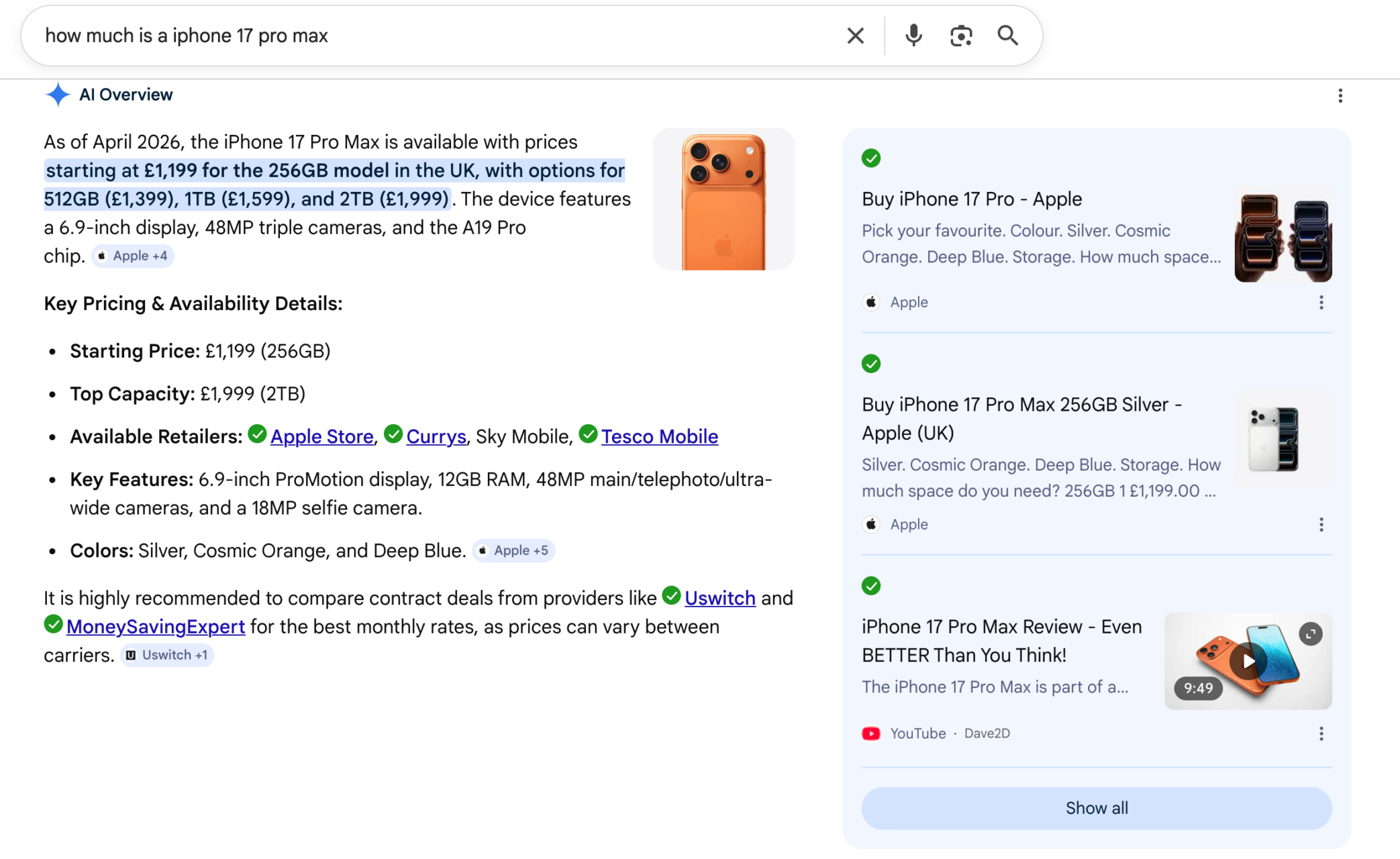
Through it’s very quick search, Google’s AI model will understand that Apple is the most reliable source to answer this question, measuring how many times other websites have cited it. Checking backlinks with ahrefs.com, Apple’s iPhone 17 Pro Max product page is cited 121 across the web, whilst UK retailers EE and Amazon are cited 0 times. As other websites have trusted the Apple product page as a resource over other competing pages, the AI model considers this the most reliable resource for giving you the most relevant answer.
Now that the AI model has identified the page it trusts to give the right information, it needs to find the appropriate answer. This is where AI search models need a bit of extra help, because unlike humans, their comprehension of context is fundamentally basic. This is where Schemas come in, cleverly breaking down page content so an AI model can find the exact information it requires.
What does the schemas look like that AI use?
These are generated as lines of code with very specific indicators. Your page viewer won’t even know they’re there, but AI search engines will!
Looking at the iPhone 17 Pro Max example, here’s what the code for the Schema might look like to help AI models specifically find the price on the page:
{
“@context”: “https://www.apple.com/uk/iphone-17-pro/”,
“@type”: “Product”,
“name”: “iPhone 17 Pro Max 256GB Cosmic Orange”,
“offers”: {
“@type”: “Offer”,
“price”: “1199”,
“priceCurrency”: “GBP”,
“priceValidUntil”: “2026-11-25”,
“availability”: “https://www.apple.com/uk/shop/buy-iphone/iphone-17-pro/6.9-inch-display-256gb-cosmic-orange”
}
}
This is a very basic example of a Schema using the JSON-LD format. There are a multitude of Schema styles you can use and naturally, a full Schema would be a lot more complex. What this illustrates however is the product name, the exact price and information that the AI model should be generating, think about it like signposting information.
How do you create a schema for AI search results?
Implementing a Schema is technical, involving input directly into your web page HTML code. There are plugins you can use to generate and implement schemas onto the page for you, which simplifies the entire process,such as: Schema Pro, Review Schema and Yoast. At Kensa, our team of developers can complete this for you as part of our website service, so you don’t have to worry about getting to grips with the right plugin.
What are the top ways to optimise for AI searches?
There’s a lot to consider (and remember!) when optimising your website content for AI. Based on all the above we’ve discussed, here’s your checklist for AI optimisation.
Clear Headings and Sections
Helps AI identify if your content answers a query request. Clear headings help AI models scan through content efficiently.
Alternative text on imagery
AI can’t interpret visuals clearly; a text descriptor can help AI contextualise the relevance of an image.
Refreshing and updating content
Keep it fresh. AI is on a mission to find the most relevant and contemporary source of information. Your content answers a question perfectly today, but its relevance could change tomorrow. Update content regularly to maintain its relevance and retain AI citation performance.
Maintain some of the regular SEO strategies
AI uses traditional EEAT models like traditional search engines, therefore layer on new considerations of AI search on top of optimisations you should already be doing.
Using Schemas correctly
Correctly implementing Schemas in your webpages code will help AI search models understand the context of your content more effectively, and allow it to find content that’s relevant to the search prompt its constructing an answer too.
Looking for a website that’s professional and optimised for the AI search world? Let’s discuss your web project.