






The brief
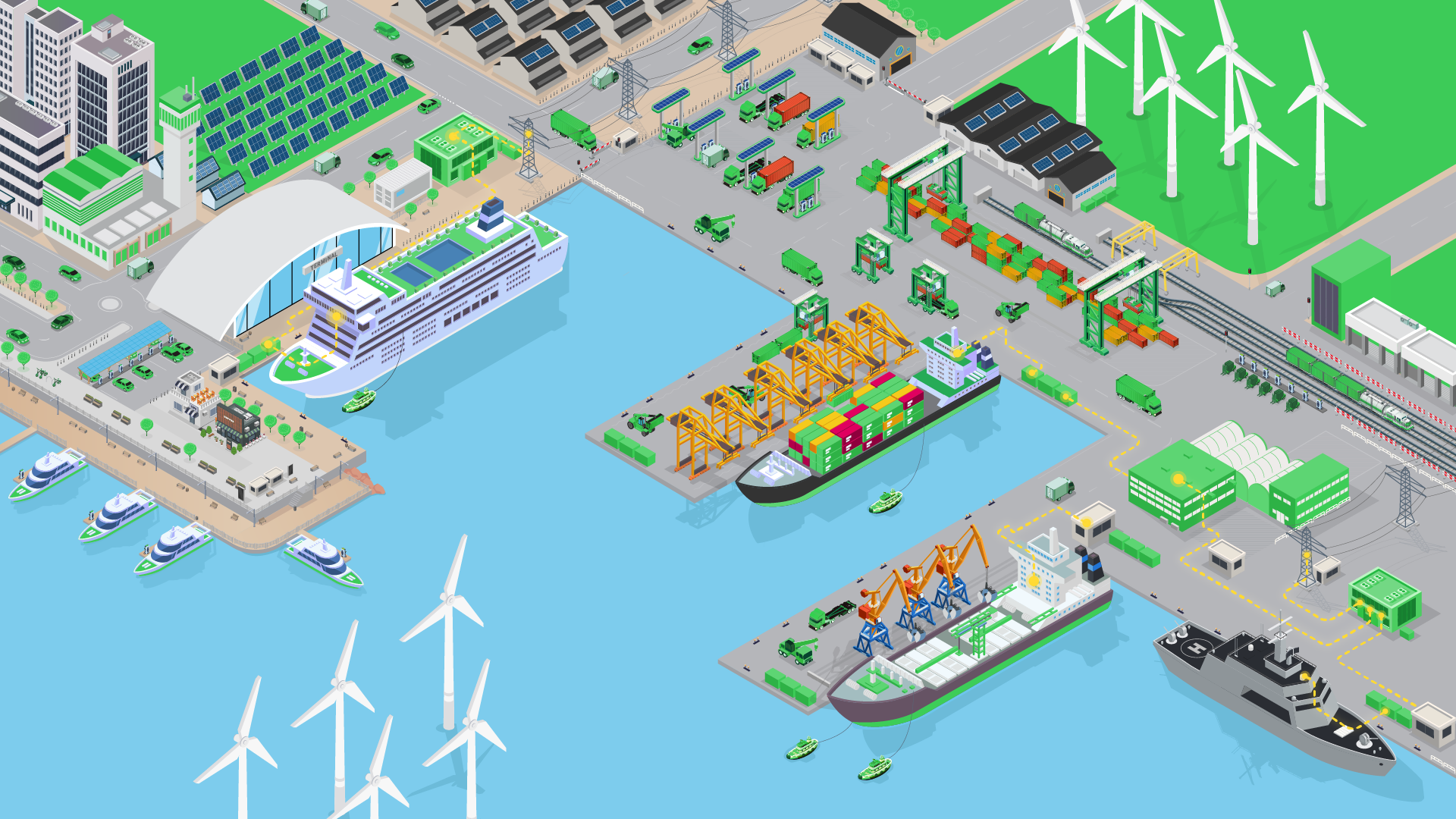
For this project, the brief was concise; take existing isometric visuals of a ‘green port’ and update it to be more aligned with their most current brand guidelines.
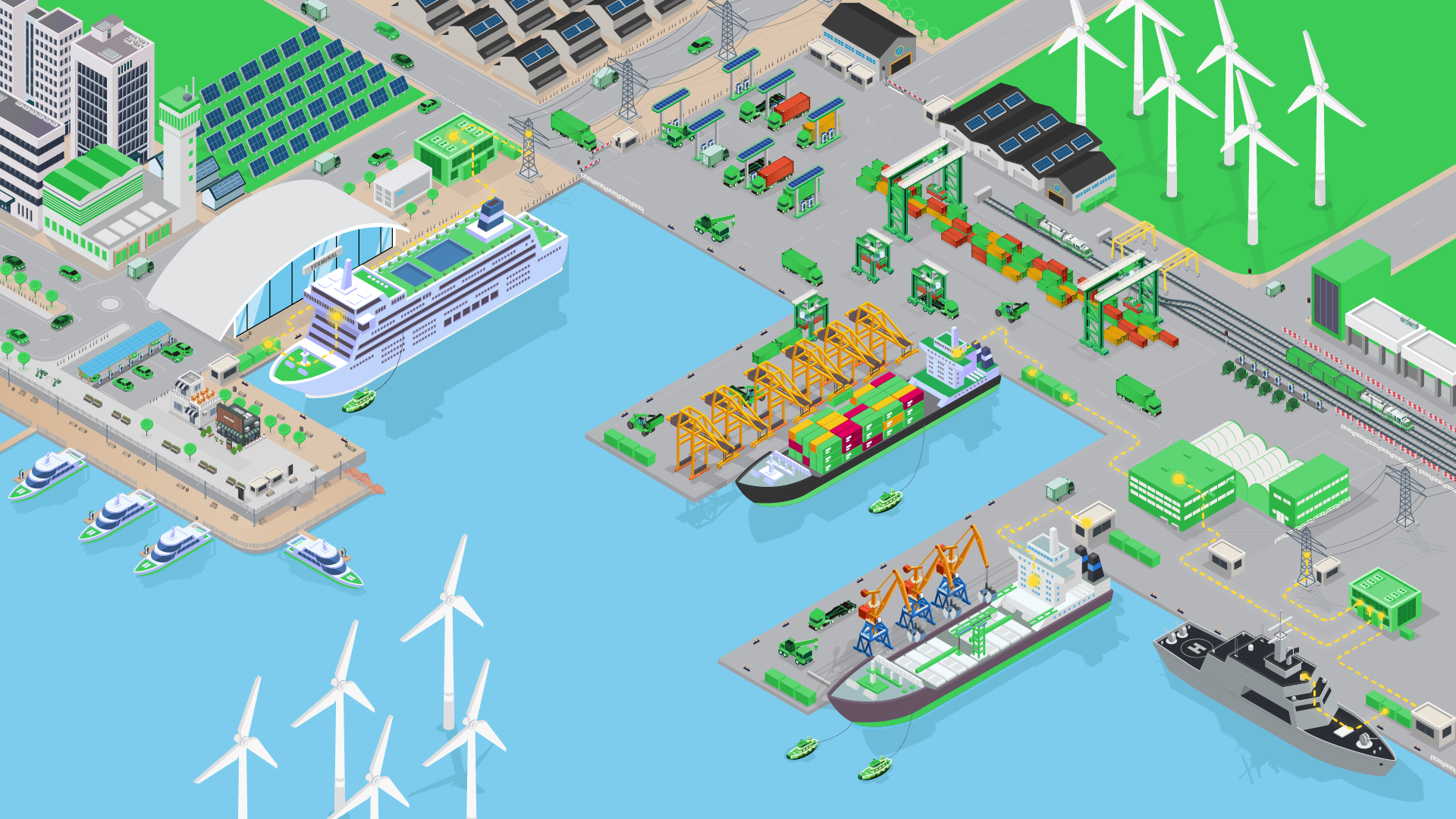
The visual needed to be reimagined and developed to strategically depict the client as an industry leader in energy transition. Set against a 21st century smart port environment and utilising the whole port infrastructure, the visuals needed to include everything from containers, cruise ships, navy vessels, renewables, electrification and digital applications. The illustration also needed to showcase technological leaps that smart technology has brought to ports to deliver sustainability and connectivity.
Getting started
You’d be mistaken for thinking: “Updating an image to be within new brand guidelines – that’s just a few minor tweaks and a colour palette swap”. Due to the brand guideline update, a colour palette change was inevitable, but the main change for the illustration was in the addition of new components. As part of the process, our team drew and added new components that are currently used in ports in the real world. Delving this deep into the world of smart ports had our designer, Andy, suddenly finding himself in the position of becoming a dockside machinery expert – and fast! Andy meticulously researched each dock component and machinery such as; RTG Cranes, Trucks, CHE charging stations, and different types of boats and terminals.
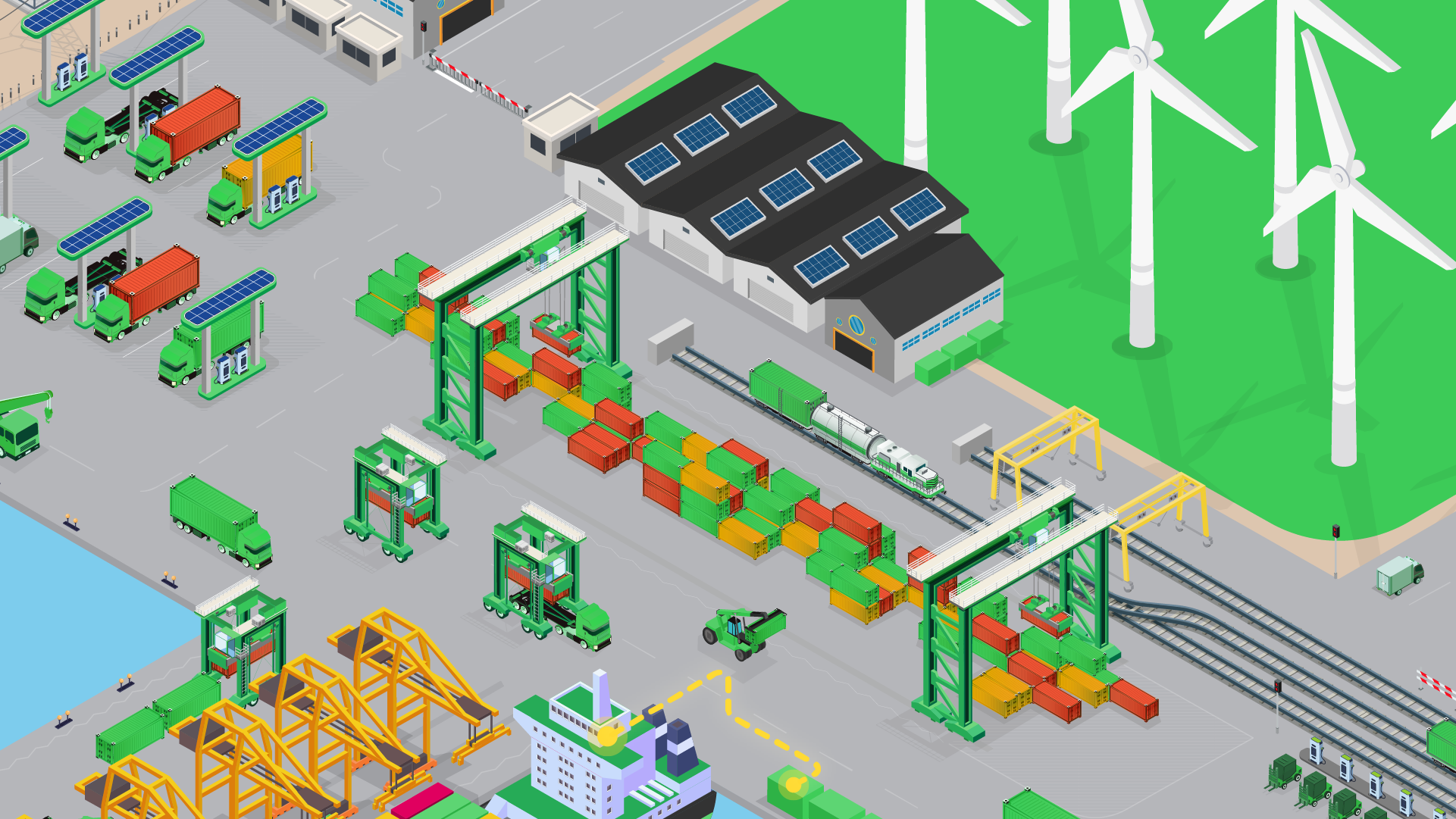
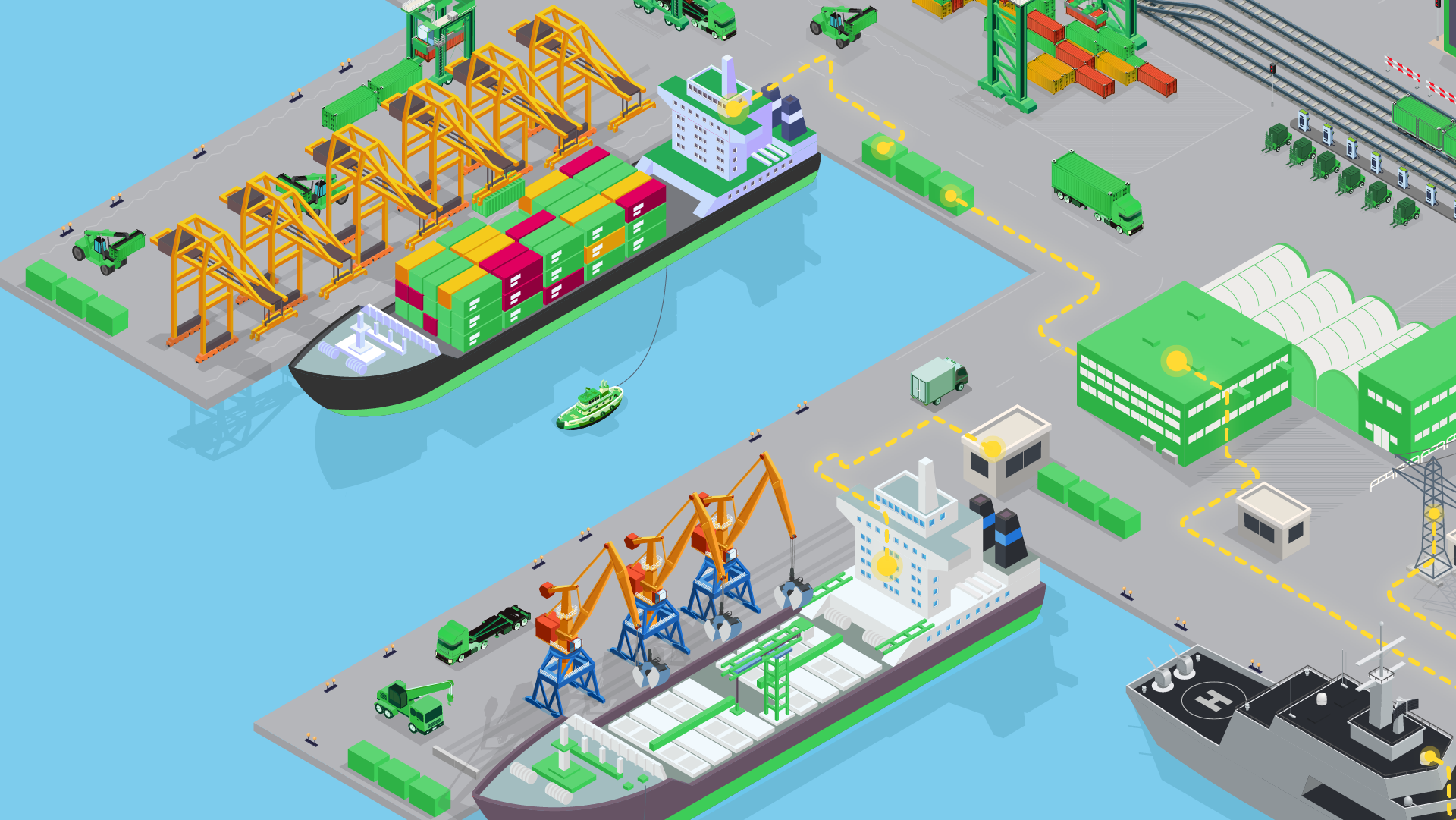
Next he had to composition each individual component in to one image, ensuring it was positioned correctly in relation to how energy supply flows through the dock from its energy source. This included mapping a power network across the smart dock image that would align with how it would work in the real world. Andy had to precisely ensure that power lines, solar panels and wind turbines were connected to power distribution centres and connect these to shore connection units that supply docked vessels and EV charging docks.
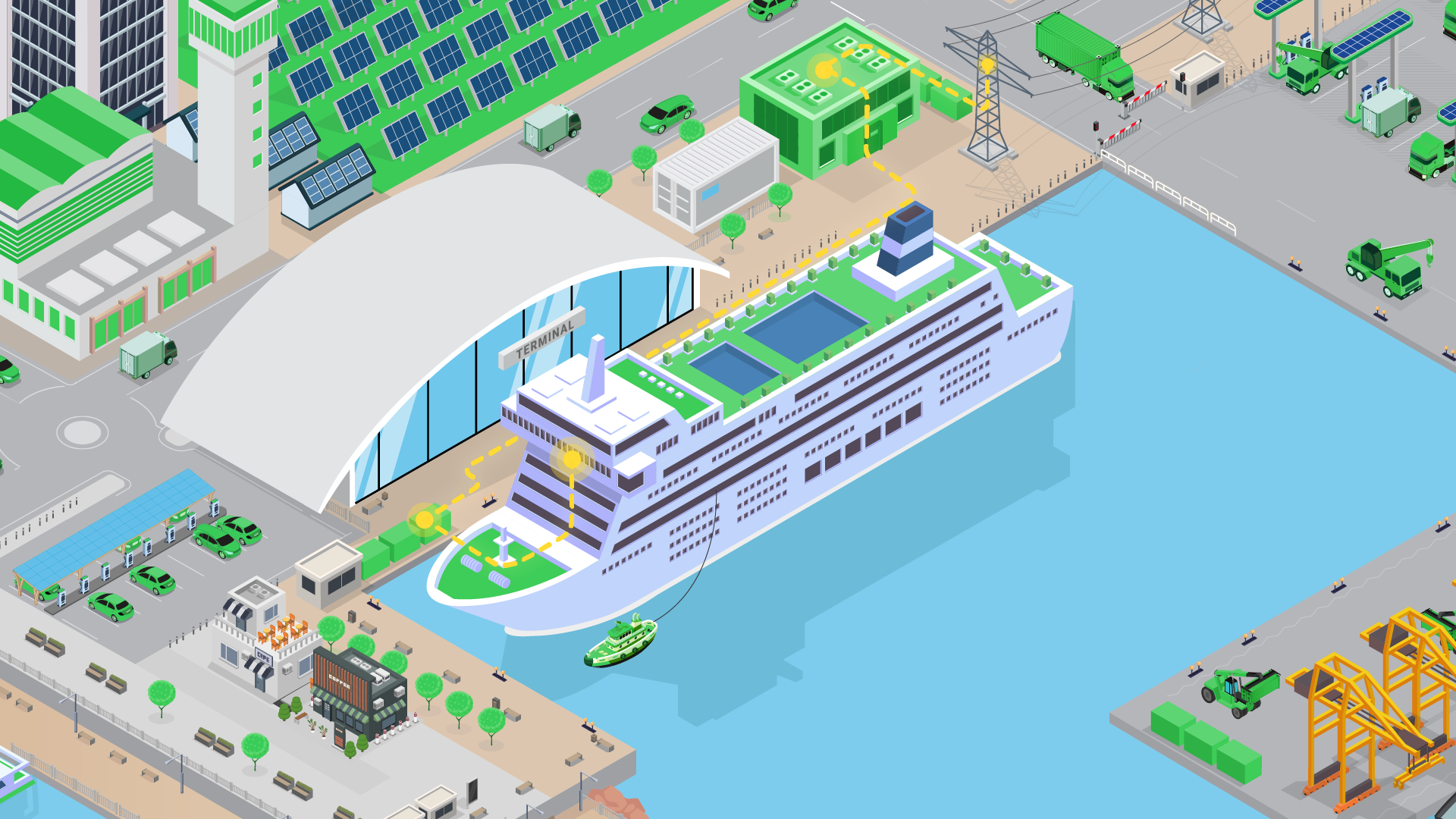
Once the energy infrastructure and dock had been mapped out, it was time to take the imagery sourced and redraw every component in an isometric style.
Why isometric imagery?
Here’s a 2D image we created as part of an animation for another client, Paycare.

To add depth we’ve used a combination of effects including scaling to make objects closer to the foreground bigger and those in the background smaller. The added motion blur also gives the feeling of the car moving towards the viewer. Drawing the ground at a curved angle and making the front of the road in the foreground wider than it is at the back also gives the illusion of depth. Albeit this is an image within 2D, the clever use of these effects acts as depth cues for our brain, which automatically interprets the image as a 3D space.
Why not 3D?
For an image that has a simple message or is depicting something like driving a car, 2D images are brilliant for getting this across quickly. But something like a dock with multiple components of different proportions and a connected energy network layered on top – it could be too complex to depict without an alternative solution.
The logical conclusion would be “Let’s model it all in 3D”. This is a very fair assumption, but there are some things to consider with a 3D approach. This form of illustration takes much longer to complete which could affect deadlines, whilst also costing more to produce as a result. By utilising an isometric perspective on a 2D image, you can greatly expand the boundaries of a regular 2D drawing, giving an illusion of 3D space on a 2D plain. So for something like a dock visual, we used the isometric perspective to cram the whole scene, its components and the electric network all in to one concise drawing – without it being overwhelming and confusing for the viewer.
The result
Andy and the client spent a few meetings ironing out some details, including reviews of if the way he’d connected the network was realistic, and if the various components visually looked accurate. Upon final review, to ensure all the components were positioned correctly and that all the final details were added correctly, we successfully delivered a visual that was a cleaner and more modern interpretation of an original visual. The visual in question will now be used for multiple purposes by the client who will use it as a web header, an event banner backdrop or even a presentation background.
Want us to fully realise an environment utilising 2D illustrations? Perhaps you need a 2D animated video built from scratch or you’re looking for an environment to be created in 3D? We can do it all here at Kensa, why not get started on a project with us now so we can show you what we’re made of.