



It’s no secret that businesses are beginning to heavily pivot towards integrating AI in to their marketing strategies and processes. Design as a principle is about the generation of unique ideas and concepts, this innovational foundation of design builds bold and impactful content. However, for something that’s often quite abstract in nature, on the surface that seems to be a juxtaposition to AI, who’s algorithms are based on hard facts and unambiguous data entry.
So why are businesses pivoting towards AI for design? When should it be used? And where can design agencies still add value? Lets find out the answers.
Process efficiency
In the realms of design, AI functionality in its infancy required a lot of human input. However through the collection of this data over time, AI models are efficient in completing menial design tasks that are otherwise time consuming and can cause inefficiencies through human fatigue. AI models are beginning to learn the context of graphic design, and are even putting these processes in the palms of peoples hands. For example, tools like Google’s Magic Erase and iPhones AI powered-clean up can make removing items and people from photos instantaneous. In the past this would have been something only someone with a design skillset could achieve – and took a lot of time. So some brands are now adopting AI in this realm to free up resources and costs.

An idea factory
One of the best parts of design is bringing everyone’s expertise and creativity together to formulate ideas. A room full of creatives at the Kensa studio can really spark a lot of unique ideas, but what if you’re not a seasoned designer? AI algorithms are a database of ideas that are usually generated from the best examples of creativity, spanning years of resources and continually updating with contemporary sources. It’s a great tool to use if you’re really stuck for inspiration and need a starting point to bring your vision to life.
If designers in the past wanted to present multiple concepts to a client, this was often a laborious task of creating each concept from scratch, almost like your delivering the project multiple times. With AI, a designer can describe the concept to AI models which instantly generates a visual of how the concept will look. Some in-house brands are encouraging designers to use AI in ideation to give more time to focus on the actual deliverables.

Should we all be designing with AI?
Well yes, it does all sound great, but there are some considerations before rapidly placing AI in to every single design process.
Design is an art form and like all pieces of art, it’s up for interpretation. Have you ever scrolled down your social feeds, or watched a TV advert and felt it didn’t resonate with you or felt it was lacking something? You’ve probably encountered a piece of AI generated content, and whilst AI can clearly speed up the design process, theres one thing AI can’t do – and thats giving something heart. It works on pure facts, not subjectivity.
The other consideration is an audience’s intelligence. All too often before we’ve seen celebrities post epic-fail images where they’ve used AI editing tools to edit their images, with catastrophic results. Extra fingers, hands in the wrong places – we’re an audience that’s never looked harder than before, so if there’s an obvious mistake to be found, your audience will spot it.
To us, this means that AI in design should be mainly used as a starting point, or a way to figure out a concept that’s causing you problems. But your final designs should never be 100% AI. One of the things that we provide to clients through our branding service is a complete rollout of their brand. This means we can manipulate it within different brand colours and layouts to ensure that no matter where your logo will be placed – it will always be on brand and legible.
AI vs Coca-Cola
Theres no better example of this than taking a look at Coca-Cola’s iconic Christmas advert. For many consumers, the sheer mention of this instills the warm and festive imagery of the red trucks. You can envision them trundling through an American snowscape, the joy on peoples faces, and the awe of a boy looking up and pointing at a Coca-Cola truck as Santa becomes animates and winks. It then takes off in to the distance…or maybe its just making you really want to grab a Coca-Cola.
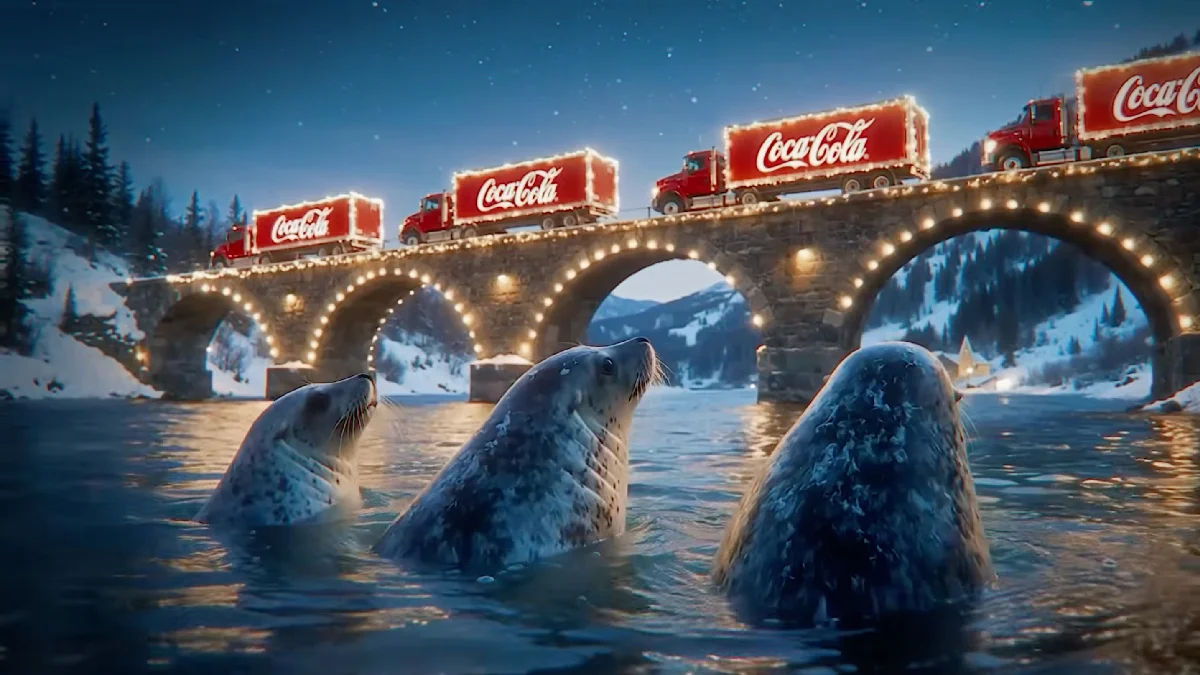
Perhaps though, your thoughts may be more on the line of: “Yes, I remember that, but it’s not been giving me the same vibe recently. I’m not emotionally connecting with it”. That’s because for the past 2 years, Coca-Cola have published purely AI generated reimagining of the classic advert. In these new versions, they feature animals looking up at the iconic trucks, instead of the togetherness of a whole neighbourhood banding together to catch a glimpse of the trucks.
Through data, AI knew what a Coca-Cola Christmas advert looked like visually, it got the essence of what an audience expects to see in order to link the advert directly with the brand. But it didn’t understand the nostalgia and the core emotional impact that the advert gives. This is where AI will likely never excel, only humans can give a design emotional impact and a unique twist.
Where we stand on AI
Our stance is simply – we can’t ignore it. It’s presence and use case is rising, but it potentially could never replace the human touch or approach design with an emotional or sympathetic approach. AI in its current form seems to be a jack-of-all-trades but a master of none; you can’t replace the context, expertise or skillset that the likes of our team can. There’s also no way to ensure that your design doesn’t include elements similar to another AI generated design (copyright infringement, anyone?).
AI is also still kinda in its infancy, but we have over 15 years of design expertise under our belt. We’ve talked to clients, we understand what they want, we know their audience inside and out and treat every project with bespoke solutions. That’s something AI cant provide.
We believe the future is simply that AI will co-exist with designers, but never replace their human touch. Do you have a design project that needs that human touch? We’re ready to talk, start a project with us.